Madrid Coach Hire for Groups and Organisers
Madrid is a large city for a coach, and a forgiving one if two things are settled early: the low-emission rules, which cover the whole municipality, and where the coach stops near each sight.
Low-emission rules: city-wide, then stricter in the centre
The Madrid ZBE covers every street in the municipality, all day, every day. Coaches registered abroad are not exempt. Since April 2026 a bus without a DGT label may drive in it on a temporary and conditional basis, never on pollution-episode days.
The historic centre is stricter. Sol, Plaza Mayor, Gran Vía and Ópera form the Distrito Centro special zone, which general traffic cannot cross. Only coaches labelled 0, ECO or C may go in, and only when they are serving a hotel or venue in the zone. Give the hotel address when you book so the operator can check access for that vehicle. The operator checks these rules again before travel.
Where the coach can stop
Coaches cannot stop in the old streets. Instead the city has signed bays for tourist and private-hire coaches: short set-down stops near the main sights, bays for stays of up to two hours, and long-stay coach parks. At a set-down bay the driver must remain in the cab with the engine switched off, for five minutes or, at some bays, fifteen. Have the group ready on the pavement before the coach pulls in.
Some bays close during matches at the stadiums, shows at Las Ventas or road works. On a match day, ask the operator for a second pick-up point.
Flying the group into Madrid
- Adolfo Suárez Madrid-Barajas Airport (MAD) — about 15 km by road from Terminal T1, and about 20 km from Terminal T4, to the Puerta del Sol, in the centre of Madrid, about 25 min by coach from T1 and about 30 min from T4 in light traffic; longer at peak times
Stadiums and arenas a coach can reach
- Estadio Santiago Bernabéu — Real Madrid CF home ground on the Paseo de la Castellana (Chamartín), rebuilt with a retractable roof; also concerts and events
- Riyadh Air Metropolitano — Atlético de Madrid home ground in San Blas-Canillejas, east Madrid (formerly Wanda Metropolitano / Cívitas Metropolitano)
- Movistar Arena (Palacio de los Deportes, formerly WiZink Center) — Indoor arena on the Avenida de Felipe II (Goya) in the Salamanca district for concerts, shows and sport; named Movistar Arena since 1 January 2025 after earlier sponsor names, so use the name on the ticket
Coach day trips out of Madrid
- Alcalá de Henares — about 34 km, about 45 min
- San Lorenzo de El Escorial (Real Monasterio) — about 48 km, about 1 h 5 min
- Chinchón — about 48 km, about 1 h
- Aranjuez (Palacio Real) — about 50 km, about 1 h
- Valle de Cuelgamuros — about 53 km, about 1 h
- Toledo — about 74 km, about 1 h 15 min
- Segovia — about 95 km, about 1 h 35 min
- Ávila — about 111 km, about 1 h 45 min
- Cuenca — about 169 km, about 2 h 30 min
- Salamanca — about 213 km, about 3 h 5 min
Coach access and parking rules in Madrid
- Adolfo Suárez Madrid-Barajas Airport (MAD): Terminal 1 is about 15 km by road from the Puerta del Sol (about 25 min) and Terminal 4 about 20 km (about 30 min) in light traffic. Journeys take longer at peak times. Check which terminal the flight uses.
- Madrid ZBE (low-emission zone) covers the whole municipality, at all times; the M-40, M-45 and M-50 motorway sections are outside it. All vehicles that enter, drive or park in Madrid must comply, including vehicles registered abroad. Passenger cars without a label (class A) not domiciled in Madrid may not drive in it. Since 7 April 2026 (Ordenanza 2/2026) vehicles without a label that are not passenger cars, including buses, may drive in it on a temporary and conditional basis, whatever their place of registration, as long as nitrogen dioxide stays within the limits; they may not drive on days of a pollution episode. These rules are current in October 2026; check them before travel.
- ZBEDEP Distrito Centro (special low-emission zone covering the historic centre: Sol, Plaza Mayor, Gran Vía, Ópera and surroundings): general traffic may not pass through. Buses and coaches serving establishments or institutions inside the area may enter only with label 0 EMISIONES, ECO or C since 2025 (label B no longer qualifies); the city handles these access permits itself. A second special zone surrounds Plaza Elíptica (Usera). The operator checks access for the specific vehicle and destination.
- Spanish low-emission zones use the DGT environmental label (distintivo ambiental): 0 EMISIONES, ECO, C and B; vehicles without a label are classed "A". For vehicles with more than 8 passenger seats and heavy vehicles, label C generally goes to vehicles registered from 2014 and label B to those registered from 2006. Vehicles registered abroad have no DGT label, and each city treats them in its own way (see the notes for each city).
- Madrid reserves signed street bays for tourist and discretionary coaches (introduced in 2007 and extended since): short set-down stops near the main sights (up to 5 minutes, some up to 15 minutes, with the driver on board and the engine off), bays for stays of up to 2 hours, and long-stay coach parking. The bays are mapped in the city geoportal dataset "Reserva de estacionamiento de autobuses turísticos y discrecionales" (updated April 2025). Some bays are not available during events at the stadiums and the Las Ventas bullring, or during road works.
- Madrid Puerta de Atocha - Almudena Grandes: the main station for high-speed trains to the south and east (Sevilla, Córdoba, Málaga, Valencia, Barcelona) and for Avant trains to Toledo. Madrid Chamartín - Clara Campoamor serves trains to the north.
- Estación Sur de Autobuses (Méndez Álvaro) is the main long-distance bus station.
- Speed limits for buses and coaches (Reglamento General de Circulación, art. 48.1.a): 100 km/h on motorways (autopistas and autovías) and 90 km/h on conventional roads. Vehicles doing school transport or carrying minors drive 10 km/h below those limits (art. 48.1.b), and a bus carrying standing passengers or without seat belts may not exceed 80 km/h on any road outside built-up areas.
- Seat belts must be worn wherever they are fitted, including in coaches (Reglamento General de Circulación, art. 117.1). In vehicles with more than nine seats including the driver, passengers must be told that belts are compulsory, by the driver, the guide or the group leader, by audiovisual means or by signs at each seat (art. 117.2).
- EU drivers' hours rules (Regulation (EC) No 561/2006) apply to coach drivers: at most 9 hours of driving a day (10 hours twice a week), a 45-minute break after 4.5 hours of driving and at least 11 hours of daily rest. Long day trips are planned around these limits.
- Some Spanish motorways are toll roads (autopistas de peaje, usually numbered AP-); the operator plans the route.
Museums, palaces and IFEMA
The Prado handles group visits as a separate booking, so reserve that slot before fixing coach times. The Reina Sofía and the Thyssen sit on the same walkable axis, so one drop-off serves all three. For a fair or congress, IFEMA is at Campo de las Naciones near the airport; staying nearby saves time in traffic.
Day trips and the long return
El Escorial is about 1 h 5 min by coach, Toledo about 1 h 15 min and Segovia about 1 h 35 min. Salamanca, at about 3 h 5 min each way, is a different matter: EU rules allow a driver 9 hours at the wheel a day, with a 45-minute break after 4.5 hours. A same-day return may need a second driver or a night away, so ask for that on the quote.
What organisers ask us
Where does a coach meet a group at Barajas?
That depends on the terminal. At T4, coaches use the bus terminal beside car park P4, next to module F, not the arrivals road. At T1 they use the bus park beside the terminal. T1 is about 15 km from Sol and T4 about 20 km, so check the flight's terminal first.
Can a coach without a DGT label drive in Madrid?
Under the current ordinance, on a temporary and conditional basis, except on pollution-episode days, and never into the Distrito Centro zone. Foreign coaches carry no DGT label, so the operator checks how the rules treat the vehicle booked.
Are there tolls around Madrid?
Some Spanish motorways numbered AP- charge a toll. The operator picks the route for each trip.
More group trips we arrange
- Coaches for Conferences, Incentives and Company Days
- School Trips by Coach: The Rules Teachers Need
- Team Travel by Coach, from Youth Squads to Clubs
- Wedding Transport for the Couple and Every Guest
- Wine Country by Coach: Rioja to the Penedès
- Coach Day Tours: Labels, Distances and Timed Entries
- Cruise Transfers: Terminal, Airport and Shore Day
- Accessible Group Travel with an Adapted Vehicle
Vehicles with a driver
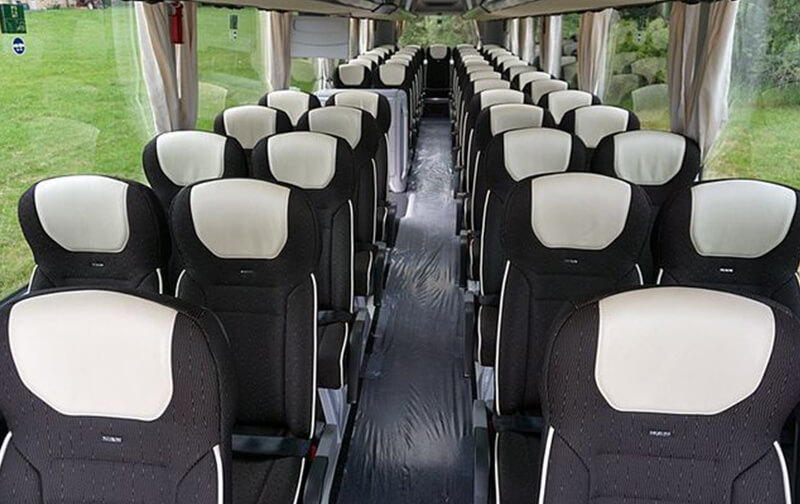
- Full-size coach (autocar) — Seats: 49-57
- Midi-coach (midibús) — Seats: 29-35
- Minibus (minibús) — Seats: 9-16 passengers plus the driver
- Executive Sprinter-style minibus (minibús ejecutivo) — Seats: 8-16 passengers plus the driver
- Executive car with driver (VTC, vehículo de turismo con conductor) — Seats: 1-3 (up to 8 passengers in a van-type car)
- Wheelchair-accessible minibus (minibús adaptado) — Seats: Varies by layout; wheelchair positions replace seats