Cordoba Coach Hire for Groups
In Cordoba the coach does not reach the Mezquita-Catedral. The streets around it are closed to collective transport, microbuses aside, so the plan is a set-down outside that area and a short walk in.
The streets around the Mezquita
Three streets ring the monument: Torrijos, Cardenal Herrero and Magistral González Francés. Cars and collective transport are barred from them, microbuses excepted, and parking there needs express permission. Beyond them, the historic centre has restricted-traffic areas (A.CI.RE), controlled by cameras and bollards.
No official source lists where a coach may set down here either, so the operator confirms the stop. For a group with limited mobility, ask about a microbus for the last stretch.
Visiting the Mezquita-Catedral as a group
Once a guided group passes 10 people, everyone needs a radio-guide headset, hired at the Patio de San Eulogio. Groups cannot use the free early entry (08:30 to 09:30, Monday to Saturday). The bell tower takes 22 people at most per 30-minute slot, and the night show takes groups of up to 100. A group of visitors with disabilities pays no entry, provided it has booked.
Flying the group into Cordoba
Stadiums and arenas a coach can reach
- Estadio Nuevo Arcángel — Córdoba CF home ground, south-east of the old town beside the river
Coach day trips out of Cordoba
- Medina Azahara — about 13 km, about 30 min
- Almodóvar del Río (castle) — about 28 km, about 45 min
- Montilla (Montilla-Moriles wine area) — about 45 km, about 50 min
- Écija — about 53 km, about 50 min
- Priego de Córdoba — about 94 km, about 1 h 40 min
- Carmona — about 107 km, about 1 h 30 min
- Antequera — about 114 km, about 1 h 45 min
- Sevilla — about 142 km, about 2 h 10 min
- Úbeda and Baeza — about 145 km to Úbeda, about 2 h 10 min
- Málaga — about 157 km, about 2 h 25 min
- Granada — about 163 km, about 2 h 40 min
Coach access and parking rules in Cordoba
- Córdoba's nearest large airports are Sevilla (SVQ), about 130 km by road from the Mezquita-Catedral (about 1 h 50 min), and Málaga-Costa del Sol (AGP), about 168 km (about 2 h 35 min). Journeys take longer at peak times. Many groups arrive by high-speed train from Madrid, Sevilla or Málaga.
- The historic centre has restricted-traffic areas (Áreas de Circulación Restringida, A.CI.RE), controlled by cameras and bollards; vehicles need an authorisation from the Oficina A.CI.RE to enter.
- Around the Mezquita-Catedral (Calles Torrijos, Cardenal Herrero and Magistral González Francés) general traffic is not allowed and collective transport is not allowed either, except microbuses; parking there is prohibited without express authorisation. Coaches set down outside this area.
- No official list of coach set-down points or a current low-emission-zone rule for Córdoba was found for this file; the operator confirms the stopping point and the rule for the vehicle booked.
- Spanish low-emission zones use the DGT environmental label (distintivo ambiental): 0 EMISIONES, ECO, C and B; vehicles without a label are classed "A". For vehicles with more than 8 passenger seats and heavy vehicles, label C generally goes to vehicles registered from 2014 and label B to those registered from 2006. Vehicles registered abroad have no DGT label, and each city treats them in its own way (see the notes for each city).
- Córdoba Central station has high-speed trains to Madrid, Sevilla and Málaga; the bus station is beside it.
- Speed limits for buses and coaches (Reglamento General de Circulación, art. 48.1.a): 100 km/h on motorways (autopistas and autovías) and 90 km/h on conventional roads. Vehicles doing school transport or carrying minors drive 10 km/h below those limits (art. 48.1.b), and a bus carrying standing passengers or without seat belts may not exceed 80 km/h on any road outside built-up areas.
- Seat belts must be worn wherever they are fitted, including in coaches (Reglamento General de Circulación, art. 117.1). In vehicles with more than nine seats including the driver, passengers must be told that belts are compulsory, by the driver, the guide or the group leader, by audiovisual means or by signs at each seat (art. 117.2).
- EU drivers' hours rules (Regulation (EC) No 561/2006) apply to coach drivers: at most 9 hours of driving a day (10 hours twice a week), a 45-minute break after 4.5 hours of driving and at least 11 hours of daily rest. Long day trips are planned around these limits.
- Some Spanish motorways are toll roads (autopistas de peaje, usually numbered AP-); the operator plans the route.
Judería, Alcázar and the patios
The Judería and the Calleja de las Flores are narrow and on foot. The Alcázar de los Reyes Cristianos is west of the Mezquita by the river, and the Roman bridge leads across to the Calahorra tower. In May the patio festival fills the old town, and most patios are reached only on foot.
Medina Azahara and the wider route
Medina Azahara is about 30 minutes west. The castle at Almodóvar del Río is about 45 minutes, and Montilla, for Montilla-Moriles wine, about 50. Seville is about 2 h 10 min, Malaga 2 h 25 min and Granada 2 h 40 min, so Cordoba often sits between two of them on a touring route. Whether a low-emission rule applies here could not be confirmed officially; the operator checks for the coach booked.
What organisers ask us
Which airport do groups use for Cordoba?
Mostly Seville (roughly 1 h 50 min, about 130 km) or Málaga-Costa del Sol (roughly 2 h 35 min, about 168 km). Many groups come by high-speed train instead.
Can the coach meet the train?
Yes. High-speed services from Madrid, Seville and Malaga stop at Córdoba Central, and the bus station is next door.
Can we use the free early hour at the Mezquita?
Not as a group. The free entry from 08:30 to 09:30 is closed to groups.
More group trips we arrange
- Coaches for Conferences, Incentives and Company Days
- School Trips by Coach: The Rules Teachers Need
- Team Travel by Coach, from Youth Squads to Clubs
- Wedding Transport for the Couple and Every Guest
- Wine Country by Coach: Rioja to the Penedès
- Coach Day Tours: Labels, Distances and Timed Entries
- Cruise Transfers: Terminal, Airport and Shore Day
- Accessible Group Travel with an Adapted Vehicle
Vehicles with a driver
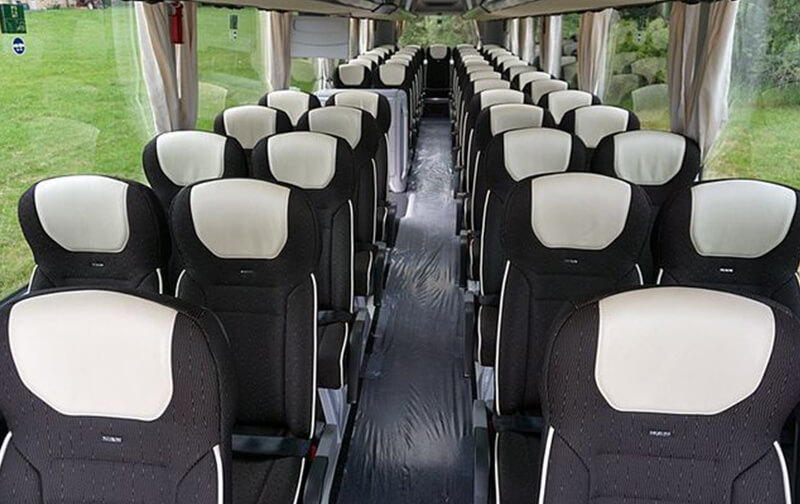
- Full-size coach (autocar) — Seats: 49-57
- Midi-coach (midibús) — Seats: 29-35
- Minibus (minibús) — Seats: 9-16 passengers plus the driver
- Executive Sprinter-style minibus (minibús ejecutivo) — Seats: 8-16 passengers plus the driver
- Executive car with driver (VTC, vehículo de turismo con conductor) — Seats: 1-3 (up to 8 passengers in a van-type car)
- Wheelchair-accessible minibus (minibús adaptado) — Seats: Varies by layout; wheelchair positions replace seats