Coach Hire for Cruise Calls in Palma
Palma's port lies in front of the old town, with its cruise berths spread along it. First find out which berth the ship will use.
Breakwater or inner quay
Ships tie up at maritime stations on two quays. One is the long west breakwater (Dic de l'Oest). The other, the Moll de Ponent, is shared with passenger ferries. They are different pick-up points, and the berth depends on the ship, so send it with the ship's name and date.
Every passenger leaving a ship heads out by the seafront avenue, and a big call means moving a lot of people in a short window. Build that into the timings.
To the airport and the cathedral
From the breakwater, the airport run covers some 14 km and takes about 25 minutes when roads are clear. Coaches stop in front of the terminal, in the outside Arrivals area, with a limited free time.
The cathedral and Plaça de Cort are about 5 km away, around 15 minutes. No official list of central coach set-down points was found; the operator confirms the stop.
From the ship to the coach
- The berth depends on the ship, so check whether it uses the Dique del Oeste or the Muelle de Poniente before planning a transfer.
- The centre of Palma (Plaça de Cort, by the cathedral) is about 5 km by road from the Dique del Oeste, about 15 min by coach in light traffic.
- Cruise passenger traffic leaves the port along the Avenida Gabriel Roca (the Paseo Marítimo); the port authority describes big cruise calls as needing to move many passengers in a very short time.
- The port authority has announced a sea shuttle (Bus Nàutic) linking the maritime stations of the Dique del Oeste and the Muelle de Poniente with the Muelle de La Lonja, near the centre: lines 2 and 3, for cruise passengers, are due to start on 1 November 2026, and line 1 on 15 January 2027.
- Under an agreement for 2027 to 2031 between the Govern de les Illes Balears, Palma City Council and the cruise lines, at most three cruise ships may call in Palma on the same day, and only one of them may have more than 5,000 berths; ships with fewer than 500 passengers are outside this limit.
- The same agreement lowers the daily average of cruise berths (counted weekly) from 8,500 to 7,500 from June to September in 2027, 2028 and 2029.
Airports for this port
- Palma de Mallorca Airport (PMI) — about 14 km from the Dique del Oeste, about 25 min by coach in light traffic
Island rules that touch the booking
Coaches and drivers are based on the island. Palma's ZBE takes in everything within the Avingudes and the seafront avenue. Labels B, C, ECO and zero are admitted until the end of 2026; B drops out in 2027. Buses appear on the city's list of permitted vehicles, though nobody has confirmed that private hire counts. That is the current rule; the operator checks it before travel.
Palma limits cruise calls from 2027. A sea shuttle for cruise passengers, the Bus Nàutic, should start on 1 November 2026, running to La Lonja by the old town.
Into the Tramuntana
The Serra de Tramuntana, a UNESCO World Heritage landscape, is the classic excursion. From the city, Valldemossa is about 20 km (35 minutes) and Sóller about 25 km (40 minutes). Sa Calobra, about 61 km and 1 h 40 min, is down a mountain road with hairpin bends: ask whether a midi coach suits it better.
What organisers ask us
How long is the ship-to-airport transfer?
About 25 minutes from the breakwater berths. Allow more when several ships are in and the seafront road fills up.
Will the coach reach the cathedral door?
No. The centre is a low-emission zone with narrow lanes; the group walks from the agreed stop to the cathedral and the Almudaina.
Does the Bus Nàutic replace a coach?
It may help passengers going into town alone. A guided group, or anyone with luggage for the airport, still needs the coach.
Cities
Vehicles with a driver
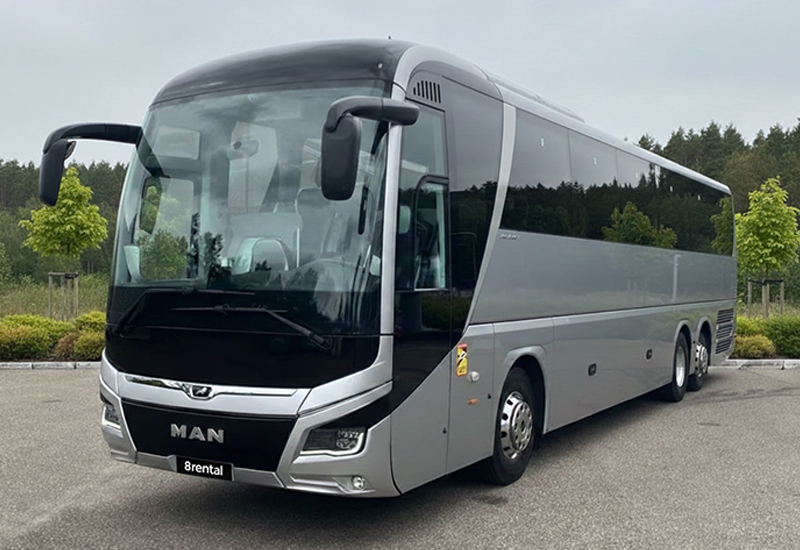
- Full-size coach (autocar) — Seats: 49-57
- Midi-coach (midibús) — Seats: 29-35
- Minibus (minibús) — Seats: 9-16 passengers plus the driver
- Executive Sprinter-style minibus (minibús ejecutivo) — Seats: 8-16 passengers plus the driver
- Executive car with driver (VTC, vehículo de turismo con conductor) — Seats: 1-3 (up to 8 passengers in a van-type car)
- Wheelchair-accessible minibus (minibús adaptado) — Seats: Varies by layout; wheelchair positions replace seats